Posts Tagged ‘ Aid

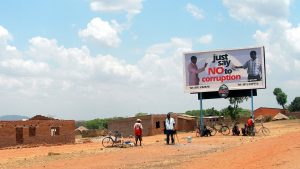
What we’re reading: election posters from Africa; a banker’s confession; boring headlines; The World Bank gracefully taking criticism on the chin?

Source: ironic anti-Zuma poster found in north western suburbs of Johannesburg prior to the 2009 election, by Christo Doherty

Monkey still working. Baboon gotta wait small: Muyatwa Sitali presents his pick of recent election slogans from across Africa.

Podcast of the week: The Guardian’s global development podcast: spotlight on the battle against global poverty

Confessions of a banker: Why I am leaving Goldman Sachs. It’s not everyday that a former executive director of one of the most successful firms in the investment banking industry accuses their former employer of having a ‘toxic and destructive’ environment or reflects on ‘decline in the firm’s moral fiber’ in an open letter to the New York Times. Ouch!

Most boring headline of the week:

$500m of US food aid lost to waste and company profit, says Oxfam

Surely the swirling deadline-bound fast paced newsrooms of The Guardian could have packaged the alarming waste in money and trading opportunities for Third World workers with the kind of concern that the situation demands?

Here are some examples of the kinds of headlines that could (or should?) have been used:

•       Tied-aid holds poorest countries to food ransom
•       US protectionist food aid programmes subsidises unjust financial and human costs Congress must stop profit-driven food aid schemes before it’s too late!
•       Timely Oxfam report reveals the state of unfair tied food aid economy

Feel free to come up with your own news headline for this report.

Should we celebrate a decline in global poverty?

Do criticisms matter on the findings of antipoverty World Bank progress?

The World Bank’s Martin Ravallion ruefully ponders the fate of researchers on poverty – someone is always going to object to your findings:

There have also been signs of a “political cycle” in the critiques. When our up-dates (at three-yearly intervals) [of global poverty numbers] find little (or seemingly modest) progress against poverty, some of our more right-leaning critics come up with some argument as to why we are systematically underestimating that progress. The left-leaning critics are more accepting at these times. By contrast, when we find progress, such critics come up with arguments as to why we are over-stating that progress. We don’t get much critical attention from the right at these times.

The Poor Against the Powerful

Here’s a short article I wrote on ‘food dumping’ that is cross-posted from Eco-Age, an online UK magazine which covers a wide range of areas including ecological analysis, socially responsible shopping and sustainable fashion. It looks at how food aid doesn’t always do what it is supposed to, with often very negative consequences for developing economies.

Today, 925 million people do not have enough to eat. One in seven people in the world go to bed hungry every night and hunger kills more people every year than malaria, HIV and AIDS and tuberculosis put together. With realities such as this in our world, food aid is a necessary and sometimes crucial lifeline for people who are hungry. It is an essential humanitarian response in emergency situations. However food aid doesn’t always do what it says on the tin…

In many instances, especially non-emergency situations, food aid is not an appropriate or efficient tool and can, in fact, be very destructive on the recipient country’s economy.  This is also known as ‘Food dumping’: the process of rich countries subsidising their farmers to produce surplus goods which is then ‘dumped’ on poorer countries at a price which undercuts locally grown produce. The ‘dumping’ (free, subsidised or cheap food, sold below market prices) of food on poorer countries severely undercuts local businesses and farmers, thus driving them further into poverty by favouring the larger producers (i.e. the richer countries/economies).

Taken from the Oxfam report on food dumping, here is an excellent illustration of food dumping in action:

The USA produces only about 1.5 per cent of the world’s rice, but is the fourth largest exporter. Between 50 and 60 per cent of all US rice production is exported. As domestic consumption of rice has stagnated over the past decade, US rice producers have increasingly relied on export markets to dispose of rising production yields. When those markets have not been available, the US rice industry has frequently turned to food aid programs as a buyer for surplus rice production.

From 1997/8 to 2004/5, rice exports under food aid programs have accounted for an average of 10 per cent of US rice exports. In years when prices are low, food aid represents as much as 20 per cent of rice exports.

In 2001, US government efforts to reduce food aid purchases of rice were perceived as a crisis by the US rice industry. According to one Louisiana rice producer, ‘The sharp decline in rice food aid allocations has had a devastating impact on the rice industry… Many mills, especially in the south, are running at just 20 to 30 per cent of capacity.’ (Delta Farm Press, July 20, 2001)

In response to this crisis, Congressional leaders swung into action, with senators from the 16 rice-producing states urgently calling upon President Bush to provide immediate relief in the form of food aid and other export assistance programs. Ultimately, they were successful, and US food aid programs purchased more rice.

In light of evidence that the USA sometimes uses food aid to ‘dump’ their surplus produce, agricultural exporting countries have called for new disciplines on food aid, as part of the Doha Round of trade negotiations – which have been on-going for the last 10 years. It is also important to state that it is not only the USA who are guilty of food dumping. Subsidies, tariffs and other trade policies (such as the Common Agricultural Policy in Europe) eliminate the comparative advantage of other regions to maintain healthy economies in the developed world. The result: ‘First World’ subsidies severely undermine Third World economies.

As a result of discussions in the Doha Round, new disciplines were proposed on food aid to protect against trade distortions and ultimately, protecting local farmers and businesses. It was proposed that:

1)     Food aid should be provided in grant form only

2)     Food aid should not be linked to commercial transactions

3)     Food aid (in emergency situations) should be provided in cash forms to buy food grown locally or regionally

4)     Food aid should only be provided in response to calls from the national governments or specialised UN agencies.

For the fully detailed list, see the Oxfam report.

It is unfortunate that the Doha Round has been marred by the current global financial crisis. The challenge of the eradication of food dumping is a long term one, needing constant and vigilant monitoring from all involved. How successful these new disciplines will be (if at all), only time will tell.

Devinder Sharma, in his article Africa’s Tragedy; Famine as Commerce in 2002, remembers a speech given at the International Famine Centre in Cork, Ireland describing how maize was loaded onto ships bound for Britain at the height of the Great Irish Famine that killed more than one million people in the 1840’s. The keynote speaker paused, lamenting:

I wonder what kind of people lived at the time who were not even remotely offended at the sight of millions dying of hunger in the same village where the ships were being loaded.

It is at this point that must ask ourselves, are we still those people? Are we offended? And if we are, what are we going to do about it?

Review of the White Paper on Irish Aid

“Every day you are helping the world’s poorest people” opens the summary of the Government White paper on Irish Aid. Irish Aid is the ‘Government programme of assistance to the poorest people in the world’ – and it is our “duty to help”.  To guide how the aid money will be spent, the government in 2006 published the White Paper on Irish Aid, focusing development at the heart of Irish foreign policy. Now 6-years old, the White Paper needs reviewing. Since the “aid programme belongs to the Irish people” the review process seeks to consult with the Irish public in reviewing the current White Paper and have unveiled the White Paper Review Consultation paper.  Planned public consultations will commence from the 1st February to April 25th, 2012 across Ireland.

If you are interested in knowing more or want to attend one or more of the review meetings check out the Irish Aid website at http://www.irishaid.ie/WhitePaper/

…it’s your programme and it is delivering €639 million in 2012 to help reduce vulnerability and increase opportunity where it is needed most.

Dates for the diary on the Public Consultations now available.

National level Consultations:

Strand Hotel, Limerick          6th Feb 2012 19.00 – 21.00

Clarion Hotel, Cork   5th March 2012         19.00 – 21.00

Radisson Blu Hotel, Golden Lane, Dublin  26th Mar 2012           15.00 – 17.30

Glasshouse Hotel, Sligo       16th Apr 2012           19.00 – 21.00

Top 10 HIV-related stories making headlines in 2011

IRIN news recently published the 10 top popular stories that appeared throughout 2011 as they relate to HIV and AIDS:

1. HIV and AIDS turned 30 in 2011! The first case of HIV was reported in 1981 in the USA.  Since then, some 30 million people have died from AIDS related diseases, another 34 million are living with HIV and there are approximately 7,000 new infections each day. In relation to treatment, an estimated 6.6 million people globally were placed on Anti-Retroviral Treatment (ART) as at December 2010, but there remained some nine million people who qualified for antiretrovirals (ARVs) but did not receive them.

2. Predictions of “the end of AIDS” in which randomised controlled clinical trials revealed that ARVs could in fact help to control the transmission of HIV by up to 96 percent.

3. A blow to funding for HIV and AIDS. The ‘global financial crisis’ impacted on the worlds commitment to those living with HIV and AIDS. At a meeting in Accra, Ghana of the Global Fund to Fight AIDS, Tuberculosis and Malaria a decision was made to suspend the 11th round of funding for the period 2011 to 2013. The Global fund is responsible for about 70 percent of HIV treatment in developing countries.

For the period 2002 and 2008, spending on HIV and AIDS rose more than six-fold before levelling off in 2009. A report in 2011 by the Kaiser Family Foundation and UNAIDS found that funding fell from US$7.6 billion in 2009 to $6.9 billion in 2010 – the first time funding has decreased in more than a decade of tracking HIV and AIDS spending.

4. Disappointing news for women: Some studies on HIV prevention trials using drugs and/or placebo for women were abandoned since they failed to show effectiveness or prevent HIV infection in the women participating in the trials.

5. Yet more political HIV “blunders”: in South Africa, the premier of the Western Cape, Helen Zille, suggested that those who knowingly infected others with HIV should be charged with attempted murder, and called into question the role of the government in providing treatment for people who contracted HIV through “irresponsible behaviour”.

In Uganda, health minister, Christine Ondoa, allegedly claimed in an interview with a local newspaper that she knew of three people who had been cured of HIV through prayer.

6. Anti-gay legislation in Africa – In Uganda, a new ‘anti-gay bill’ was presented by parliament that would make “repeat offenders” subject to the death penalty.

In Nigeria the Senate voted to criminalize gay marriage, gay advocacy groups and same-sex public displays of affection, which activists fear will drive gay Nigerians further underground and away from HIV prevention and care services.

Western responses in 2011 in response to the rise in anti-gay sentiment included: in the UK, Prime Minister David Cameron threatened to withhold aid to countries violating the rights of their gay citizens; in the US Secretary of State Hillary Clinton confirmed that the Obama administration would use its foreign policy to combat efforts abroad to criminalize homosexual conduct. In Malawi, gay rights activist Gift Trapence was arrested but after a speech by Clinton agreed to review its anti-homosexuality legislation.

7. Threats to generic ARVs –referred to as the ‘pharmacy of the developing world’ India produces the majority of ARVs used throughout the developing world. The EU in 2011 continued to push for tougher intellectual property rules in its negotiations with India over the terms of a free trade agreement.

Novartis, the Swiss pharmaceutical giant, is challenging the patent laws in India with the hope of preventing the extension of drug patents for minor changes in existing products (“evergreening”). This means that if successful, India will be forced to grant more patents on drugs than they currently do, which would make it much more difficult to provide cheaper drugs to those who need them most.

8. Yet more disappointing news for women: The Lancet published a study that linked HIV transmission with contraception. The study reported that HIV-positive women who use Depo-provera – the ‘hormonal shots’ that many women in Africa rely on to help prevent unwanted pregnancies and help to control Mother to Child Transmission – doubled the chances of transmitting HIV to their partners. It has been suggested that this may be as a result of the thinning of the vaginal mucous membrane and changes to the genital tract.

9. First pharmaceutical signs with the Medicines Patent Pool – In 2010, the Medicines Patent Pool was established by UNITAID to encourage innovation and improve access to HIV medicines through voluntary licences on medicine patents that will enable generic competition and the development of new products. In 2011, Gilead Sciences became the first pharmaceutical company to sign a licensing agreement. This means that Gilead’s allows for the production of several of its HIV medicines.

10. New HIV targets – The UN High-Level Meeting on AIDS announced its new goal of “Zero new infections, zero stigma and zero AIDS-related deaths.” The declaration adopted at the meeting aims by 2015 to double the number of people on ARVs to 15 million, end mother-to-child transmission of HIV, halve tuberculosis-related deaths in people living with HIV, and increase preventive measures for the “most vulnerable populations”.

US President Barack Obama promised to provide HIV treatment to six million more people globally by 2013, which is an increase of two million on the previous target.

______________________________

For more information see the full article at PlusNews: the global online HIV and AIDS news service of the United Nations Integrated Regional Information Networks (IRIN) http://www.plusnews.org/report.aspx?reportID=94562